

In the late 1990s Iceland had one of the highest rates of teenage substance use in Europe. Parents were worried. Schools were struggling. Traditional prevention campaigns weren’t working.
So the country asked a different question. Instead of asking: “How do we stop teenagers from drinking?” They asked: “What kind of childhood makes drinking less appealing in the first place?” That question changed everything.
Researchers discovered something powerful. The strongest protective factors weren’t lectures. They were: strong family relationships, organized activities, time with parents and community connection. Belonging became prevention.
The government invested heavily in childhood. Families received support for: sports, music, arts, dance & swimming. Children weren’t simply told what not to do. They were given something meaningful to do instead.
Parents became part of the solution. Schools encouraged families to eat together, know where their children were and spend more evenings together. Communities agreed on shared expectations. Connection replaced isolation.
Many communities introduced voluntary evening curfews. Not as punishment, but to reduce unsupervised late-night time. The goal wasn’t control. It was creating safer environments for teenagers.
The results were extraordinary. Between 1998 and recent national surveys1, teen alcohol use dropped from about 42% to around 5%, daily smoking fell from about 23% to around 1% and hashish use also declined substantially. One of the biggest public health turnarounds in Europe.
The lesson wasn’t ‘Keep children busy.’ It was ‘help children feel they belong’. Research consistently links strong parent-child relationships and structured extracurricular activities with lower risk-taking behaviours.2
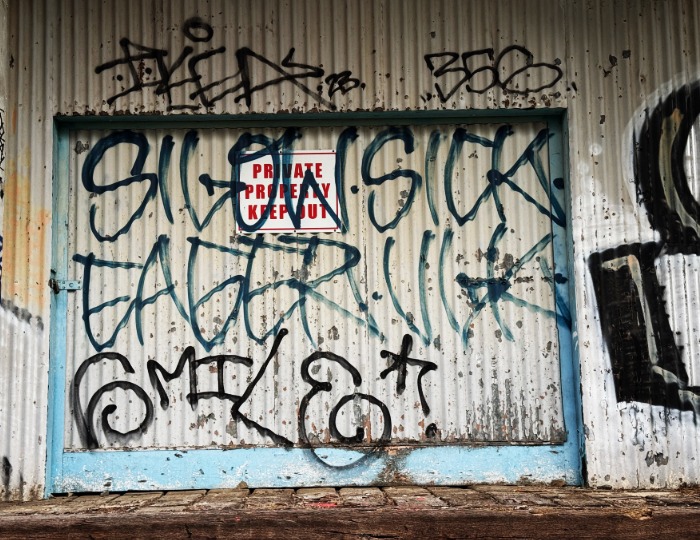
While travelling through rural NSW I came across a derelict building covered with graffiti, an old mattress, cans and food wrappers – and later in Adelaide I saw graffiti under a bridge, marks of people wanting to be seen.
These scenes are ubiquitous, if one wants to look. How many of us have written/scratched/rattle-canned our name/tag at least once in our life?
It struck me that there may be a connection between time spend tagging with a few mates in an abandoned building and nurture. And that is a time in our lives when we may be struggling to be seen, to have a voice.
I am not suggesting a link with drugs, hard or soft (alchohol is a drug), nor am I suggesting criminal activity, apart from the tenuous charge of graffiti.
Graffiti can sometimes be just a scrawl of blind rage, a scream against a world of neglect.3
Can the ‘scrawl of blind rage’ be a symptom of a society that does not value it’s youth?
The derelict building that inspired my textile work is on the outskirts of a village in rural NSW Australia. In 2021, it had a population of 112, with 11 people between the ages of 10 and 19.4 This is not an isolated example by any means. Graffiti can be found around almost every village, town and especially city. Isolation is not just geographic. Graffiti is, partly, a need for nurture, inclusion, having a voice, having something meaningful to do that appeals to and engages youth.
Graffiti is always political. The cry for help that is not seen, let alone recognised. The immediate response from authorities is that graffiti is vandalism, illegal access, endangerment to self or others, etc. It takes an enlightened civic authority to see artistic merit. But mostly authorities want to whitewash the signals that they actually do not offer disaffected youth anything. Graffiti is rebellion.
There are countless examples of graffiti on Roman ruins in Rome, Pompeii and other places, words written 2000 years ago5. It’s a natural thing to do, an instinct to make one’s mark, to sign that ‘I exist, and I was here’, and to leave a message.
Aboriginal hand stencils and neolithic rock drawings are all examples of art that could be saying, at least in part, ‘I was here’, while leaving a message such as ‘good hunting here’, or ‘waterhole’.
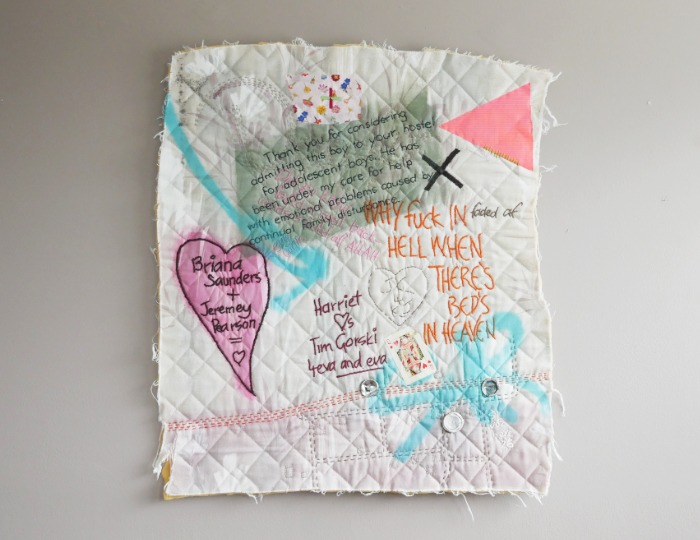
And of course some graffiti is just a private/public notice of something personal: Briana Saunders loves Jeremey Pearson, Luke Timms is a dog, It is right to rebel. It is these I find most revealing. Although strong social commentary can be found in graffiti art I am not interested in copying another artists’ work. Tags and comments can reveal the joys and hurts and observations that (usually) young people are thinking and ‘publishing’ when they are alone or amongst their peers**.
These observations are from under bridges, inside and outside deserted buildings, in culverts, on old water tanks and on railway carriages. And they are mostly from two states in Australia. The graffiti here is not from a state at war, or politically oppressed – the concerns in such places are different.
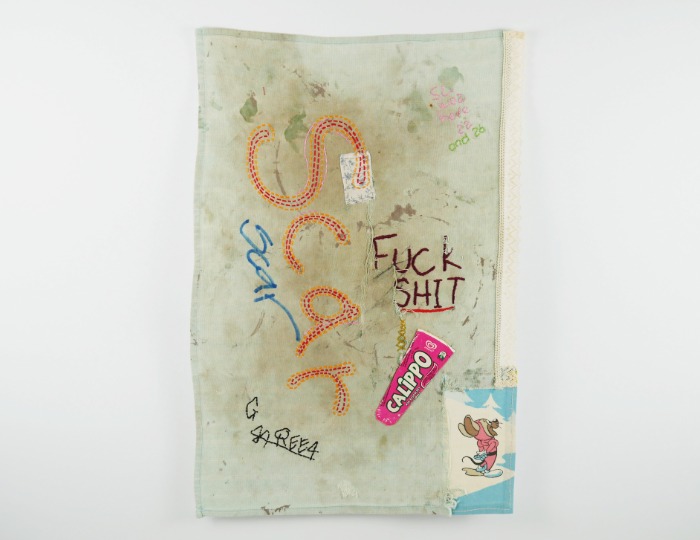
Completed in August 2026, Scar tells a story: the mouse sourced from a pillow case, the Calippo paper cup and the graffiti rage, all attached to a stained, worn-out tea towell. There was nurture, but was it enough? Did life get too hard, too hopeless?
Embroidering someone’s graffiti on a tea towel is re-writing the words of disaffection with the love and patience of traditional, homely fabric practices. How would someone’s angst be transformed with the care that family and society could bring? These are samplers of the undercurrent of our society. I am making a connection between disaffected youth and family/societal care. Graffiti does not automatically mean a youth without nurture, however we live in a time where the housing situation is worsening, and homeless shelters are overwhelmed and not well funded. Domestic violence is not really being addressed at government level, and unsettled families lead to more young people couch surfing or on the streets.
The rise of AI and international political tensions also has an impact. Basic necessities are more expensive, and governments are distracted by far right agendas that threaten the safety of marginalised groups. Climate change is real, yet governments seem unwilling to act, possibly because of vested interests. I believe these all impact on how helpless young people feel. What future can they look forward to?
Where possible I am using found or donated fabrics and materials for the structure of my work. For example, old mattress ticking, cushion covers and tea towels. These are links to home and may end up in abandoned buildings. For example a dumped mattress might be dragged into an abandoned building at the edge of town, to provide an ad hoc clubhouse, out of sight of adults and rules.
I think it is integral to the work to find materials the same way kids might. It adds a level of authenticity and the stains and damage on old materials add to the story.
This essay is a work in progress.
____________________________________
*working title
**I did search for any names used, and found no references. It felt right, then, to keep the names as they were. They are not used in a detrimental way.
1 Article posted on Instagram in July 2026 by theparenthoodinsider
2 https://planetyouth.org/the-icelandic-prevention-model/
3 John Simmons in Free, UK 2002
4 https://www.abs.gov.au/census/find-census-data/quickstats/2021/SAL21502
5 https://kashgar.com.au/blogs/history/the-bawdy-graffiti-of-pompeii-and-herculaneu